 LOOKSMAXXING
Why Your Selfie Is Not Your Face: Camera Distance, Lens Distortion & Better Progress Photos
A lot of looksmaxxing happens through a phone camera, which is convenient and also a terrible measuring instrument when the phone is six inches from your face. If you have ever looked fine in a mirror, opened the front camera and suddenly thought your nose, midface or jaw changed shape, that is not you imagining things. Perspective really does change the proportions.
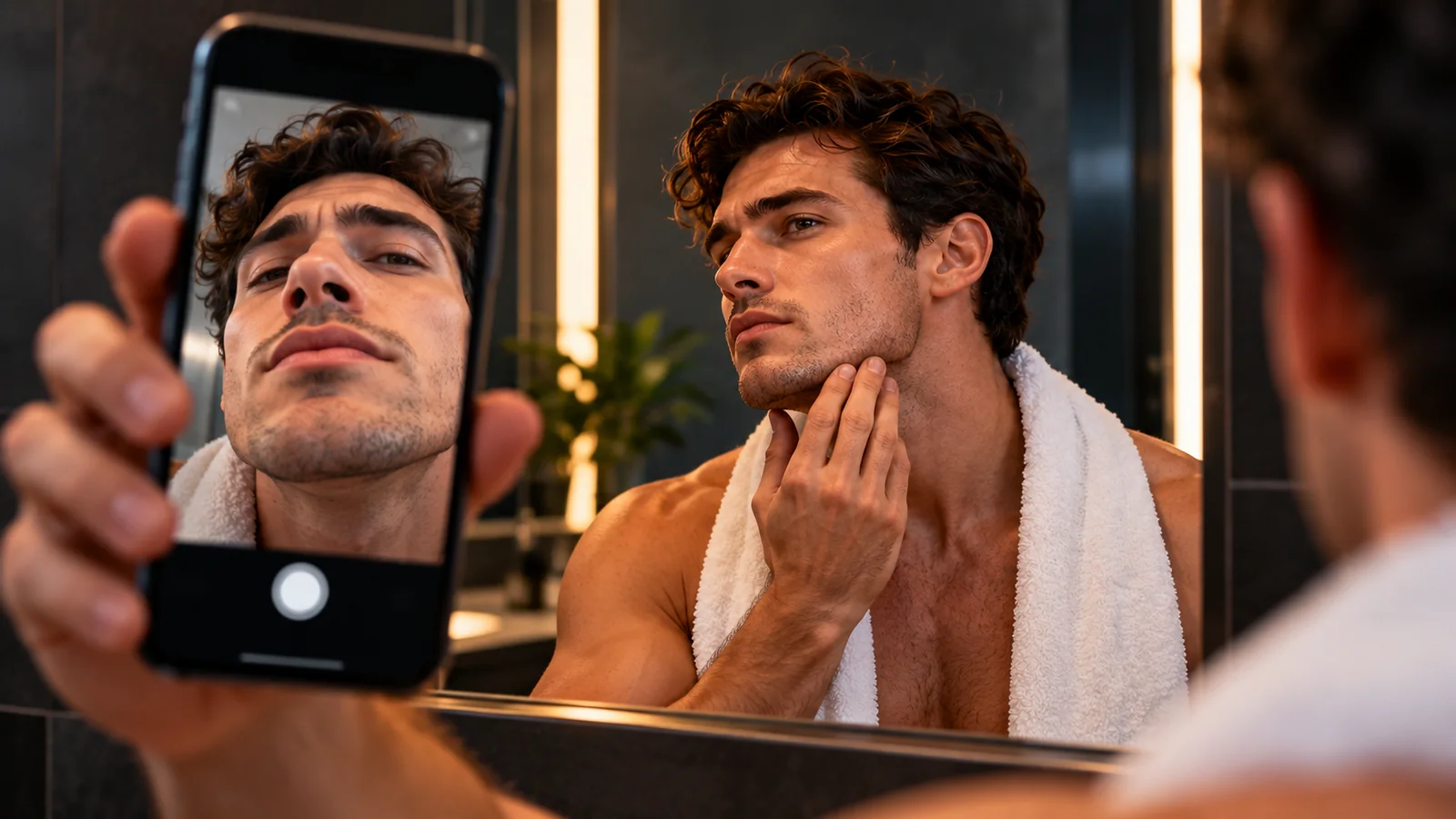
Distance is the big variable. A camera very close to your face exaggerates features that sit closer to the lens and shrinks features farther away. Moving the camera back and using a longer focal length or crop produces a more portrait-like rendering.
1. Perspective is doing more work than most people realize
A face has depth. The tip of your nose is closer to the camera than your ears, jaw angle and sides of the face. When the camera is close, those distance differences become a larger percentage of the total camera-to-subject distance. The near features therefore occupy more of the image.
This is often called “lens distortion,” but for faces the practical culprit is usually perspective from camera distance. A wide phone lens encourages you to stand close because it can fit your whole head in frame. A longer lens encourages you to stand farther back. If you put two cameras at the same distance and crop them to the same framing, the perspective is essentially the same.
2. The study everyone in the community should know
Ward and colleagues modeled short-distance photography in a 2018 JAMA Facial Plastic Surgery paper. Their model found that a photo taken at about 12 inches increased perceived nasal size relative to facial width by roughly 30% in men and 29% in women compared with an orthographic reference. At 5 feet, the distortion was essentially negligible in their model.
That does not mean every selfie makes every nose exactly 30% larger. Phones differ, head shapes differ, and people hold cameras at different distances and angles. The useful point is the size of the effect: a normal phone setup can move facial proportions enough to swamp the subtle changes people are trying to judge from skincare, debloating, body composition or grooming.
You do not need Photoshop to create a dramatic facial change. Move the phone farther away, raise it two inches, change the head angle and use harder side lighting. That can create a bigger visual delta than weeks of the actual intervention.
3. A progress-photo setup that is boring on purpose
If you are tracking changes, the goal is not to make yourself look best or worst. The goal is to remove variables. Pick one setup and keep it.
- Back up. Put the camera roughly 1.5 m / 5 ft away when space allows.
- Use the rear camera. A 2× or 3× camera can be useful if it lets you fill the frame from farther away. Avoid ultra-wide.
- Keep the camera at eye level. Not under the chin, not above the forehead.
- Use repeatable light. Same room, same window or lamp position, similar time of day.
- Take three views. Front, three-quarter and side. Neutral expression first; smiling photos can be a separate set.
- Compare monthly, not hourly. Skin, fluid retention, hair and body composition need time. Daily photos mostly measure noise.
4. Mirror vs rear camera vs front camera
The mirror is reversed, so it looks more familiar because that is the version you have seen thousands of times. Photos are usually not reversed, which can make ordinary asymmetry feel more obvious simply because it is unfamiliar. Neither version is “fake.” Other people see you in motion, at changing distances, from many angles, with binocular depth cues. A single frozen frame is always a reduction.
| Tool | Good for | Watch out for |
|---|---|---|
| Mirror | Grooming, hair, skin texture at normal standing distance | Reversed familiarity; bathroom lighting can be brutal or flattering |
| Front camera | Convenience, video calls | Usually too close; beauty processing or mirroring may be enabled |
| Rear camera at distance | Progress photos, outfit / posture checks | Needs tripod or timer; match distance and height each time |
5. Selfie-based ratings are especially noisy
If you use community ratings or an app score, the input image matters. One close selfie can penalize nose-to-face ratios, midface width, jaw projection and even eye spacing compared with a farther portrait. That does not mean all rating systems are useless; it means the image needs to be standardized before you treat a one-point change like a biological fact.
For community feedback, I would rather see one neutral 5-foot front view and one three-quarter view than ten dramatic selfies. If you want style feedback, add a normal standing photo. If you want skin feedback, add a close-up separately. Different questions need different photos.
Take one photo today from 12 inches and one from 5 feet, matching head angle as closely as you can. You will immediately see why a front-camera close-up should not be your baseline for deciding whether your face “needs” something.
6. What focal length actually changes
Focal length changes framing. Perspective changes because of where the camera is. In practice the two get bundled together because a 24–28 mm-equivalent phone camera makes you move close, while a 50–85 mm-equivalent portrait setup makes you back up. That is why people say “use 2×” or “use a portrait lens.” The useful instruction is really: increase camera distance, then use the lens or crop that gives you the framing you want.
If your phone's 2× mode is a digital crop rather than a separate lens, that is still fine for comparison photos if the light is good. You are not entering a photography contest. Consistency matters more than extracting maximum sensor quality.
7. Angle can change the read as much as distance
Camera height changes the apparent relationship between the chin, jaw, neck and forehead. A low camera can emphasize the jaw and nostrils. A high camera can make the lower face look smaller. Turning the head a few degrees changes how much of the far jaw angle is visible. Pushing the chin forward can sharpen the neck-jaw boundary without changing anything anatomical.
That is not cheating when the goal is to take a good photo. It only becomes a problem when you compare an optimized “after” to a neutral “before” and treat the difference as proof of an intervention.
A useful two-set system
- Tracking set: boring, neutral, same distance, same camera height, same expression.
- Presentation set: use flattering angles, posture and light. This is the set for profiles, dating apps or style checks.
Separating those jobs is underrated. You do not need to make your progress photo ugly, and you do not need to make your best photo scientifically standardized.
8. Phones may be processing more than you think
Modern phones can apply HDR, sharpening, local contrast, skin smoothing, face-aware exposure and other computational processing. Some apps add beauty filters by default. Even when there is no obvious “filter,” the camera pipeline can render texture and shadows differently between lenses.
For tracking, use the same camera app and the same lens. Turn off explicit beauty modes. Do not mix a screenshot from video, a front-camera portrait-mode frame and a rear-camera photo and then compare pore texture or facial width.
9. Real people are seen in motion
A static image freezes an expression at one millisecond. In person, attractiveness is also affected by eye contact, voice, smile timing, posture, hair movement, how the skin reflects changing light and a thousand microexpressions. That does not make photos irrelevant. It means a single frame is a narrow sample of how a face reads.
This is especially relevant if you are judging asymmetry. Everyone has some. Motion often makes small asymmetries less salient because the brain is integrating changing views rather than measuring a frozen line.
10. My standard photo protocol
| Variable | Use this |
|---|---|
| Distance | About 1.5 m / 5 ft |
| Camera | Rear camera when possible; 2× is fine if it helps framing |
| Height | Lens at eye level |
| Light | Diffuse window light or the same room light |
| Views | Front, 45° left/right, side |
| Frequency | Every 4 weeks for slow changes; weekly only for short debloat experiments |
| Expression | Neutral tracking set + optional smiling set |
If puffiness is the thing changing day to day, use the 14-Day Facial Debloat Protocol. For the full face stack, go to the Face Guide.
Selected references
- Ward B, Ward M, Fried O, Paskhover B. Nasal Distortion in Short-Distance Photographs: The Selfie Effect. JAMA Facial Plastic Surgery. 2018. Source.