 LOOKSMAXXING
Bone Smashing: The Mechanism, the Risks, and Better Ways to Chase the Same Goal
If you spend time in looksmaxxing spaces, you already know why bone smashing keeps coming back: bone remodels under load, so it feels like there should be a way to push that process toward a sharper face. The missing piece is that remodeling under controlled biological load is not the same thing as repeatedly hitting your cheekbones or jaw. Here is the useful version of the argument without pretending the idea came from nowhere.
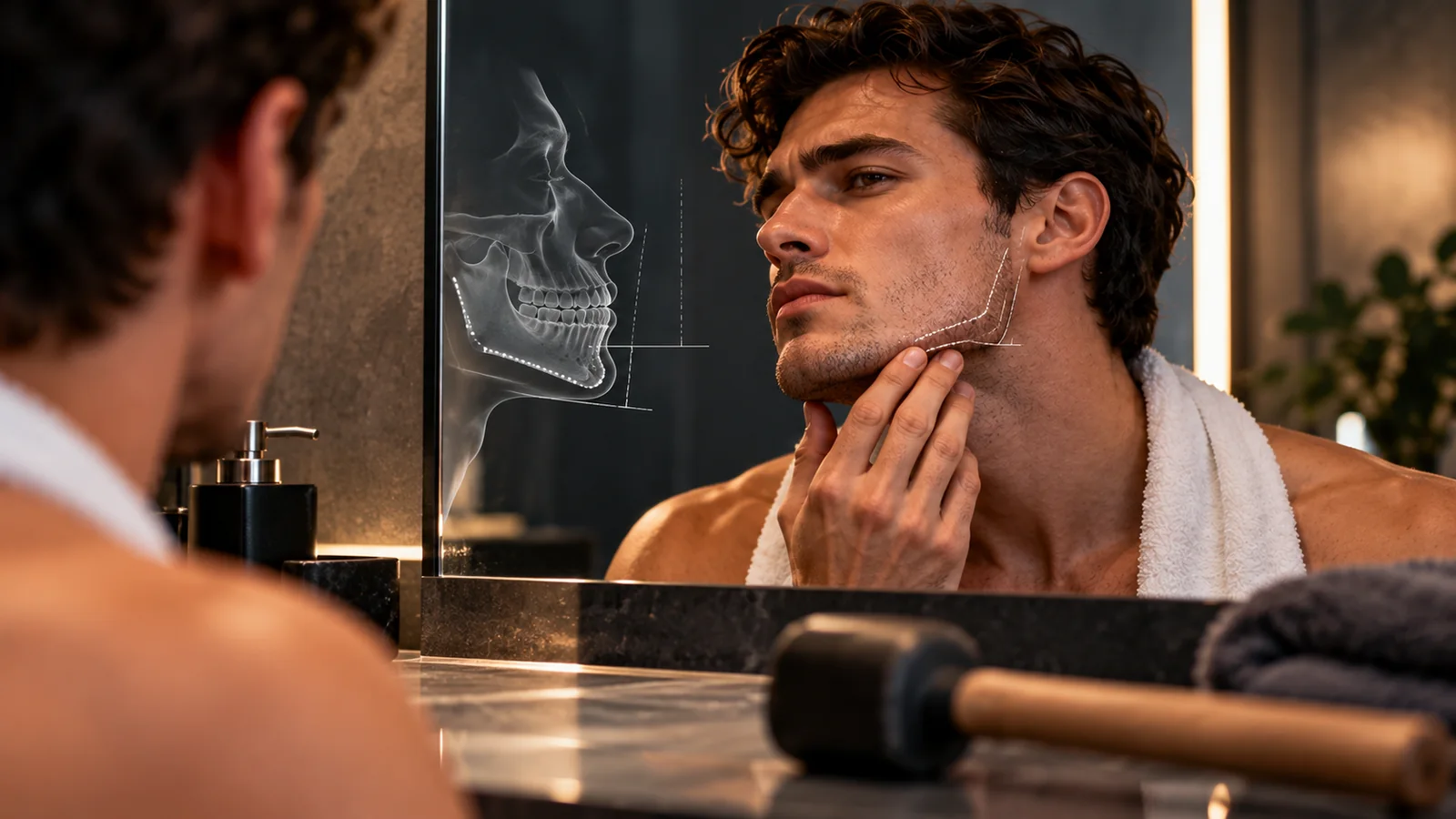
There is no clinical protocol showing that repeatedly striking an adult face creates a more attractive or predictable bone shape. There is very real evidence that blunt facial trauma can fracture the jaw or midface, change the way the teeth meet, injure sensory nerves, and damage structures around the eye. If the goal is more definition, this is a high-risk tool aimed at the wrong layer.
1. Why the idea sounds plausible
The pitch usually starts with a real concept: bone is living tissue. It responds to mechanical forces over time. Orthodontics moves teeth through bone, resistance training can affect bone density, and fractures heal by building and remodeling tissue. From there, it is tempting to jump to: “if force changes bone, targeted impacts should change facial bone.”
The problem is the jump. Different tissues respond to different kinds of force, magnitude, frequency and direction. A controlled orthodontic force applied for weeks is not biologically equivalent to blunt impact. A fracture healing into roughly its old position is not the same process as sculpting a zygoma or mandibular angle into a planned cosmetic shape.
The “Wolff’s law” part is not made up. The conclusion people bolt onto it is the weak link. Bone adapts; that does not mean random trauma is a usable facial-design protocol.
2. Remodeling is real. Precision remodeling from impacts is the unsupported part.
Adult craniofacial bone is constantly turning over at a microscopic level, but the visible geometry of your jaw, cheekbones and orbital rim is constrained by anatomy, genetics, bite mechanics and the soft tissues sitting over them. To change shape in a predictable way, medicine uses controlled systems: orthodontic forces, orthognathic surgery, implants, fillers, fat changes and sometimes bone grafting.
Repeated impact gives you none of that control. You cannot choose whether the force lands on cortical bone, a tooth root, the infraorbital nerve, the temporomandibular joint, a sinus wall or the thin bones around the eye. Even if an impact is not strong enough to create an obvious fracture, swelling alone can temporarily change the face and make an “after” photo look different for the wrong reason.
3. The risk profile is not theoretical
Blunt facial trauma is a standard mechanism for mandibular and midface fractures. Depending on the location, clinicians look for pain, focal swelling, a bite that suddenly feels different, difficulty opening the mouth, facial numbness, double vision and contour changes. Those are not edge-case internet warnings; they are the normal signs used to evaluate facial fractures.
Jaw / mandible
Fracture, altered bite, pain in front of the ear, reduced opening, numbness along the lower lip or chin.
Cheek / midface
Swelling, facial numbness, contour irregularity, difficulty opening the jaw, or dental changes.
Orbit / eye area
Thin bone around the eye can be injured; vision changes or double vision after trauma deserve urgent evaluation.
Soft tissue
Bruising, inflammation and scarring can create temporary “definition” in photos while the tissue is simply injured.
There is another practical issue: asymmetry. Even people performing planned facial surgery cannot guarantee mathematically perfect symmetry because healing is biological. Repeated self-inflicted impacts are far less controlled. If one side takes more force, swells differently or heals differently, the result can move in the opposite direction from what you wanted.
4. If you have already tried it
No lecture here. Plenty of people experiment with something after seeing convincing before-and-afters. The useful question is what to watch for now. After a significant facial impact, get medical evaluation promptly if you notice a bite that no longer lines up, persistent numbness, double vision, severe or increasing swelling, a visible step or depression in the face, bleeding that will not stop, a loose tooth, trouble opening your mouth, severe headache, fainting, vomiting, confusion, or anything else that feels neurologically off.
If it is just mild tenderness from a recent attempt and none of those signs are present, the sensible move is to stop adding force and let the area settle rather than “testing” it again. Pain is not a progression metric.
5. Better tools for the exact same goal
Usually the goal is not “change my cortical bone.” It is one of four visual goals: a cleaner mandibular line, more cheekbone contrast, a squarer lower face, or a stronger side profile. Those are easier to work on when you separate structure from presentation.
| Goal | Higher-return levers |
|---|---|
| Cleaner jawline | Body composition when appropriate, normal hydration, posture, beard edge, haircut balance, consistent photo distance. |
| More cheekbone contrast | Skin quality, body-fat distribution, hairstyle, lighting, facial hair placement; professional options if you want structural change. |
| Wider / squarer lower face | Facial-hair geometry and haircut can change the read immediately. Hard chewing has weak evidence for appearance and can irritate the jaw. |
| Profile / chin projection | Posture and camera perspective first; orthodontic or maxillofacial assessment if the concern is actually bite or skeletal projection. |
That is the general approach I use throughout this site: do the reversible, high-return stuff first. If you still want a structural change after months of stable photos, then at least you are making that decision from a clean baseline rather than from a swollen selfie.
Take a neutral front, three-quarter and side photo from about 1.5 m / 5 ft away. Fix the easy variables for 30 days: sleep, grooming, skin, training, posture and camera setup. Re-shoot under the same conditions before deciding the remaining issue is bone.
6. Why the before-and-after photos can look convincing
Most bone-smashing claims are carried by photos, not scans. That matters because faces are unusually easy to change in a photo without changing the skeleton. Swelling can make one contour look more prominent while hiding another. A slightly lower body-fat level sharpens the mandibular border. Stubble can create a darker line exactly where the jaw meets the neck. A closer camera exaggerates the center of the face, while a farther camera changes the balance again.
Then there is timing. If an “after” is taken right after repeated impact, localized swelling can temporarily change the apparent projection of a cheekbone or jaw angle. That is not proof the underlying bone has remodeled into that shape. The only convincing way to establish a structural change would be standardized imaging and measurements across time, ideally with a control group. That is the kind of evidence missing here.
What would count as convincing evidence?
- Defined impact dose and location rather than “hit until it feels worked.”
- Baseline and follow-up CT or standardized 3-D imaging.
- Enough participants to separate real change from normal asymmetry and measurement error.
- Adverse-event tracking, because a cosmetic result is not useful if the method also creates fractures, dental injury or nerve symptoms.
- Independent replication rather than a single creator's protocol.
None of that means community experiences are worthless. They can generate hypotheses. They just cannot tell us whether the visible change came from bone, swelling, body composition, posture, grooming, lens distance or selection of the best-looking frame.
7. If you want a structural change, be specific about the structure
“Jawline” can mean mandibular angle width, chin projection, ramus length, submental fullness, neck-jaw angle, dental projection, facial fat or just beard contrast. Those are not interchangeable. A person with a strong mandible and higher submental fat needs a different solution from someone with a retrusive chin and a lean neck.
If the concern is bite, jaw projection or obvious skeletal asymmetry, an orthodontist or maxillofacial surgeon can tell you whether there is an anatomical issue. If the concern is purely cosmetic, a facial-plastic or dermatologic consultation can explain non-surgical and surgical options. You are still allowed to decide you do not want any of them. The value of the consult is knowing which layer you are actually looking at.
8. Quick questions that come up a lot
What about very light tapping instead of hard hits?
Lower force obviously lowers the chance of an acute fracture, but there is still no established dose-response showing that light external tapping reshapes adult facial bone cosmetically. “Safer than hitting hard” and “proven to work” are different claims.
What about microfractures?
Bone can form microdamage under repetitive load, but deliberately creating uncontrolled microdamage in facial structures is not an accepted cosmetic strategy. The face contains teeth, sensory nerves, sinuses and thin orbital bones close together. There is no clean way to target only the contour you want.
Could healing make the bone thicker?
Callus can form during fracture healing, but that is a response to injury, not precision sculpting. A healing fracture can also restore its prior contour, heal with displacement, or require reduction/fixation. “More bone tissue during healing” does not equal “better facial geometry.”
Read Why Your Selfie Is Not Your Face, then use the Face Guide to sort jawline levers by how much they can realistically change.